On January 2, 2026, the United States initiated Operation Absolute Resolve, a decisive military intervention in Venezuela aimed at stabilizing the hemisphere and dismantling the illegitimate Maduro regime. While the kinetic operations are still unfolding on the ground in Caracas, a parallel war is being fought in the information space.
We have analyzed thousands of official communiqués and social media posts on X from the first 48 hours of the operation, mapping how six distinct ideological "camps"—the US GOP, US Democrats, China, Russia, the EU, and the legacy media—are framing this historical moment. The results, visualized in the figures below, reveal a fractured reality. Each camp is not merely spinning the news; they are inhabiting entirely different ontological universes.
TL; DR
- The US Divide: The GOP frames the operation as a moral imperative against an illegitimate "regime," while Democrats are bogged down in procedural outrage ("hearing," "statement") and fear-mongering ("wars," "dire").
- The Authoritarian Mirror: China adopts a tone of sterile, bureaucratic neutrality to delegitimize US disruption. Russia, projecting its own cynicism, frames the entire operation as a resource grab ("oil").
- The European Weathervane: The EU is paralyzed by process, focusing on "meetings," "statements," and "groups" rather than outcomes.
Methodology
To cut through the noise, we deployed a custom analysis pipeline to harvest data from X (Twitter) across identified clusters of influence. These clusters included state actors (e.g., MFA China, Kremlin accounts), elected officials (US Congress), and major media outlets.
To identify the distinctive vocabulary of each ideological camp, we implemented a Log-Odds Ratio metric with Dirichlet prior smoothing [1]. This method allows us to quantify the degree to which a specific term is associated with one group (e.g., the GOP) relative to another (e.g., Democrats), while rigorously controlling for the variance in corpus size and word frequency.
The core of our analysis relies on calculating the likelihood of a word appearing in Camp A versus Camp B, adjusted for the natural scarcity of language.
- Prior Smoothing: We apply an additive smoothing parameter ($\alpha = 0.5$) to raw term counts. This technique, often referred to as Jeffrey’s prior, prevents mathematical errors for words that appear in one corpus but not the other. It also stabilizes estimates for rare words, preventing low-frequency terms from artificially dominating the results.
- Probability Estimation: For each term $w$ in Camp $i$, we calculate the smoothed frequency $\pi_w^{(i)}$:$$\pi_w^{(i)} = \frac{y_w^{(i)} + \alpha}{n^{(i)} + 2\alpha},$$ where $y_w^{(i)}$ is the count of word $w$ and $n^{(i)}$ is the total word count for the camp.
- Log-Odds Calculation: We then convert this probability into odds and take the logarithm of the ratio between the two camps:$$\delta_w = \log \left( \frac{\pi_w^{(i)}}{1 - \pi_w^{(i)}} \right) - \log \left( \frac{\pi_w^{(j)}}{1 - \pi_w^{(j)}} \right).$$
- Ranking: We iterate through the entire vocabulary, filter out noise (terms with insignificant total usage), and rank them. A large positive value indicates the word is statistically "owned" by Camp A; a large negative value indicates ownership by Camp B.
The Domestic Front: Moral Clarity vs. Procedural Paralysis
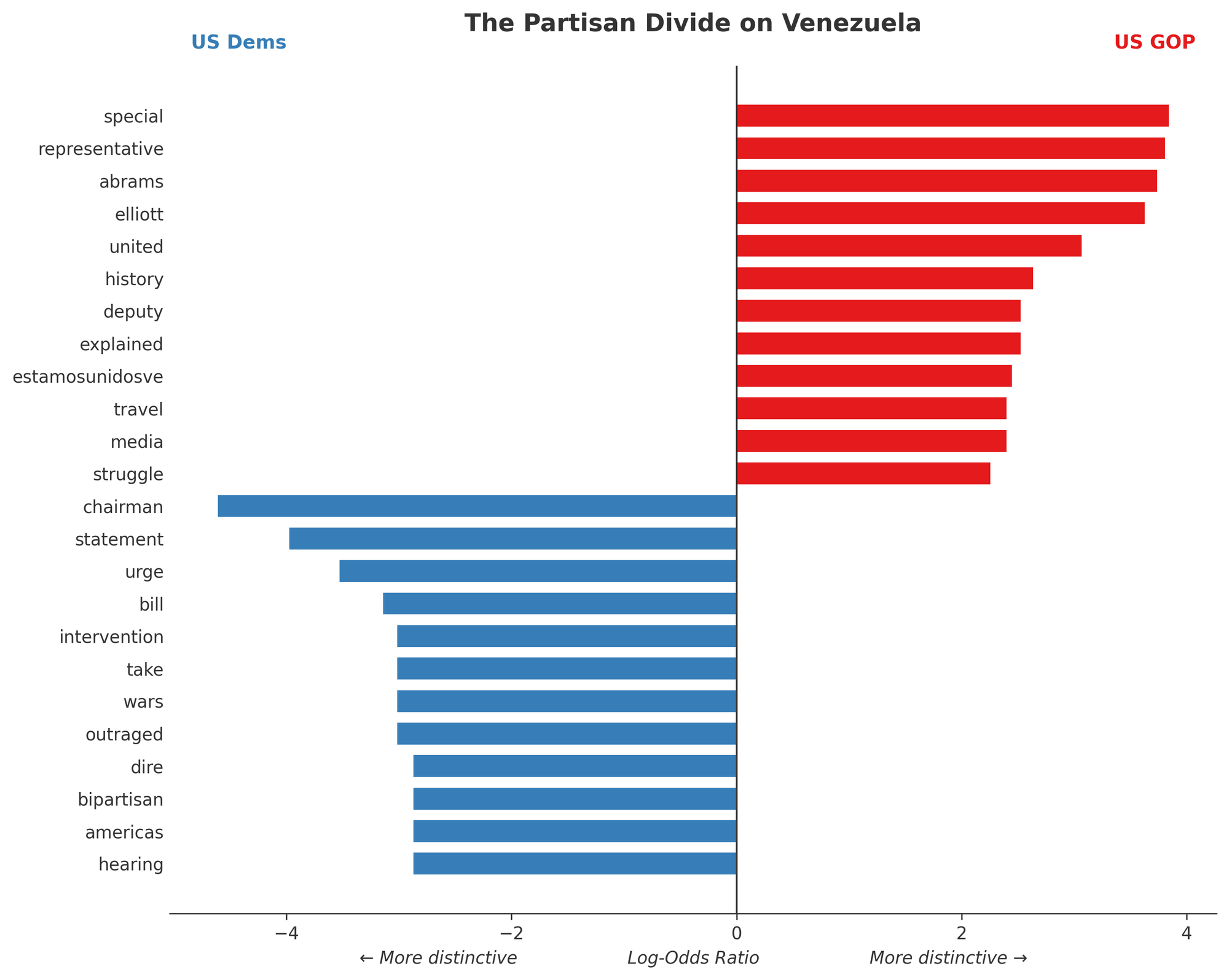
The sharpest and most revealing divergence is found within our own borders. As illustrated in the chart above, the vocabulary of the US GOP—aligned with the Trump administration’s "Absolute Resolve"—is strikingly teleological. Terms like "united," "history," "regime," and "illegitimate" dominate their discourse. This is the language of high stakes and moral clarity; it identifies a specific antagonist (the "regime") and situates the operation within a grander historical narrative of liberation.
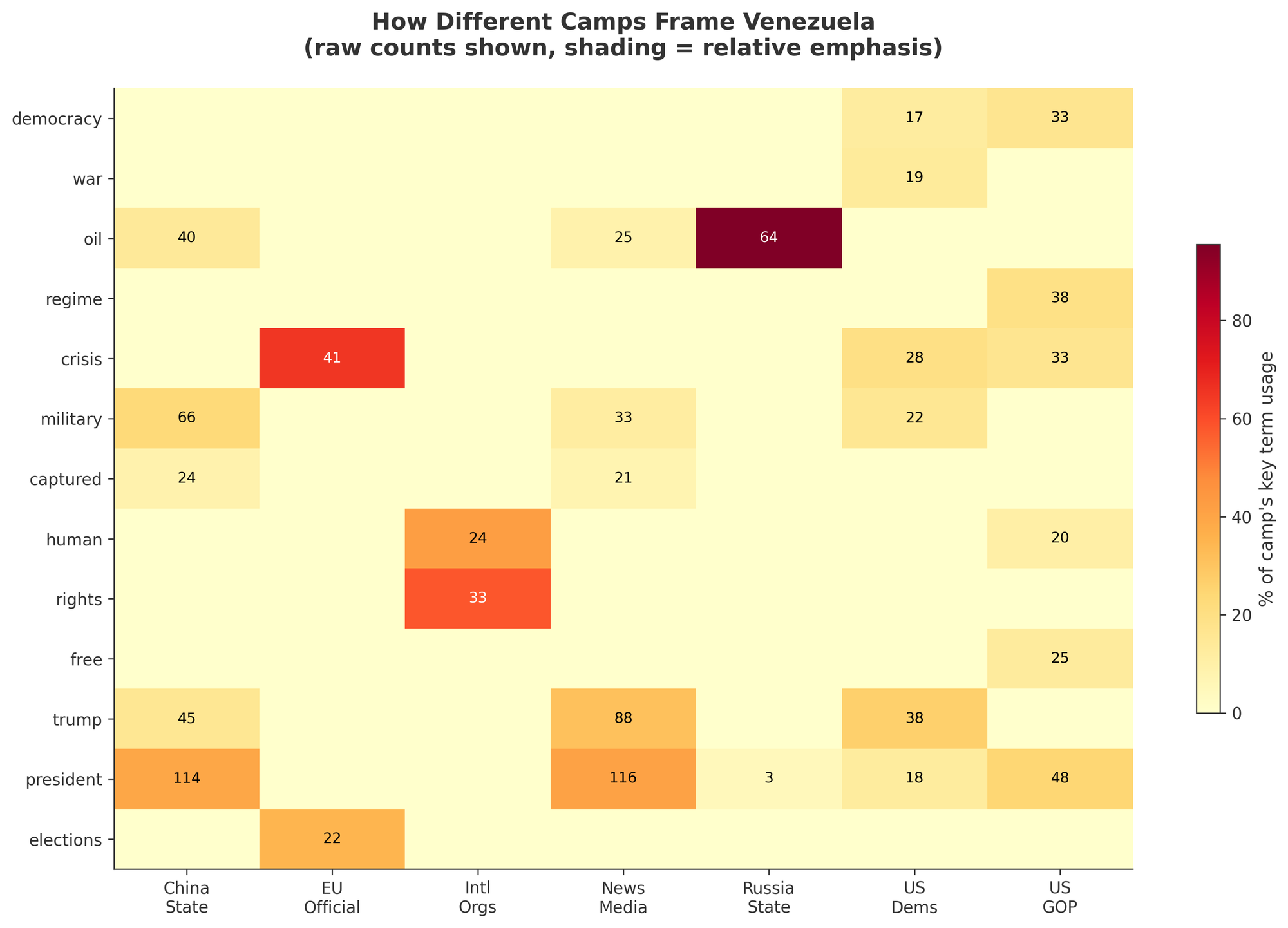
The heatmap analysis reinforces this finding, showing that the GOP dedicates a massive relative emphasis to the specific term "regime," framing the conflict not as a chaotic skirmish but as a targeted removal of a malignant political tumor. In stark contrast, the Democratic establishment appears to have retreated into a bunker of proceduralism and panic. Their distinctive vocabulary is cluttered with the jargon of bureaucracy: "chairman," "statement," "urge," "hearing," and "bill." Rather than engaging with the strategic merits of the operation, the opposition is engaging with the paperwork of Washington. Furthermore, their high usage of emotive, fear-based terms like "outraged," "dire," and "wars" places them firmly in a posture of emotional reaction. They are not arguing against the goal of a free Venezuela so much as they are hyperventilating over the process of American assertiveness.
The Cynic and the Bureaucrat: The Authoritarian Pincer
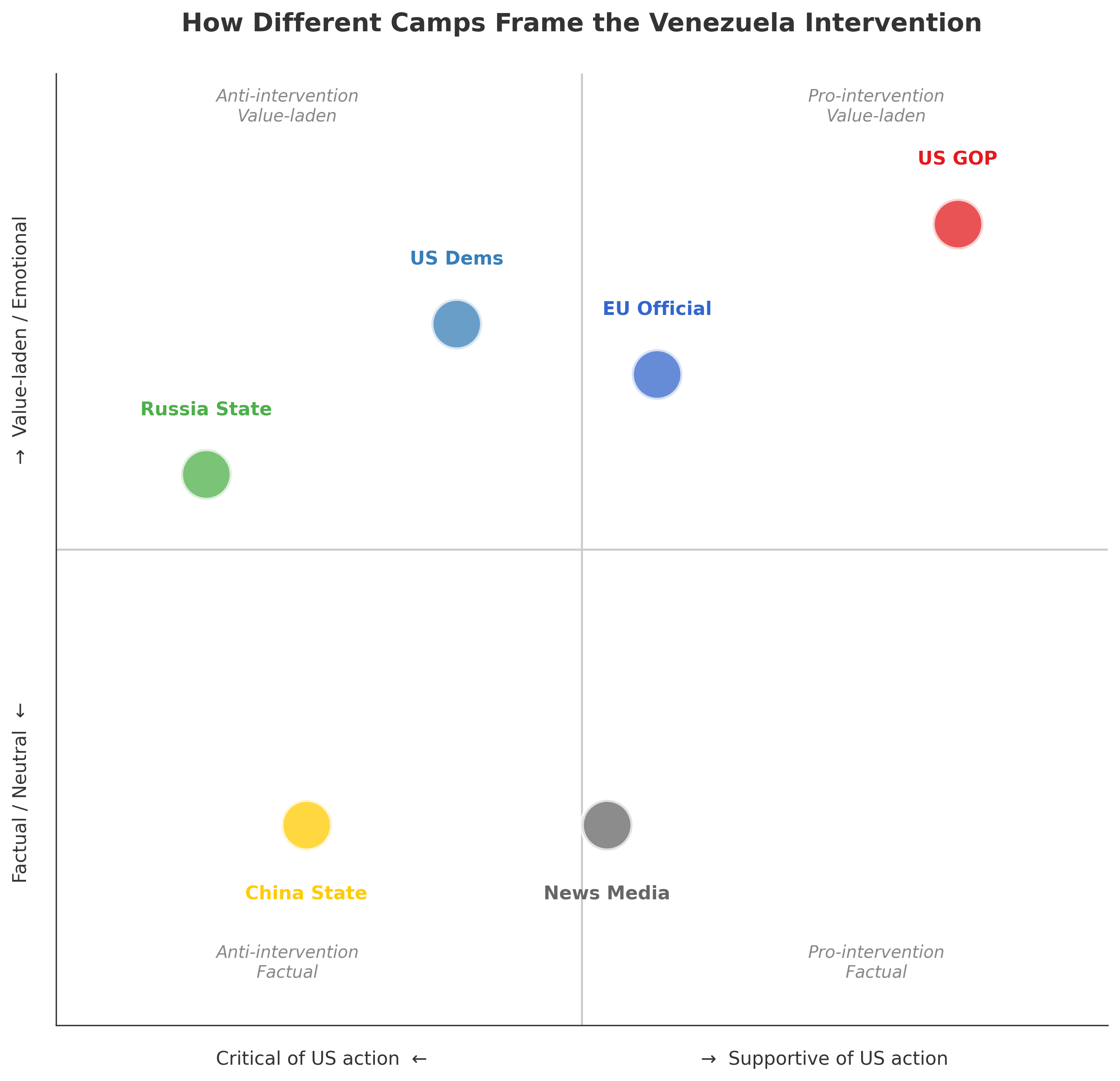
Our adversaries have adopted complementary, yet distinct, rhetorical strategies to undermine American legitimacy. The narrative quadrant analysis places Russia deep in the "Emotional / Anti-intervention" space, projecting its own cynical worldview onto American actions.
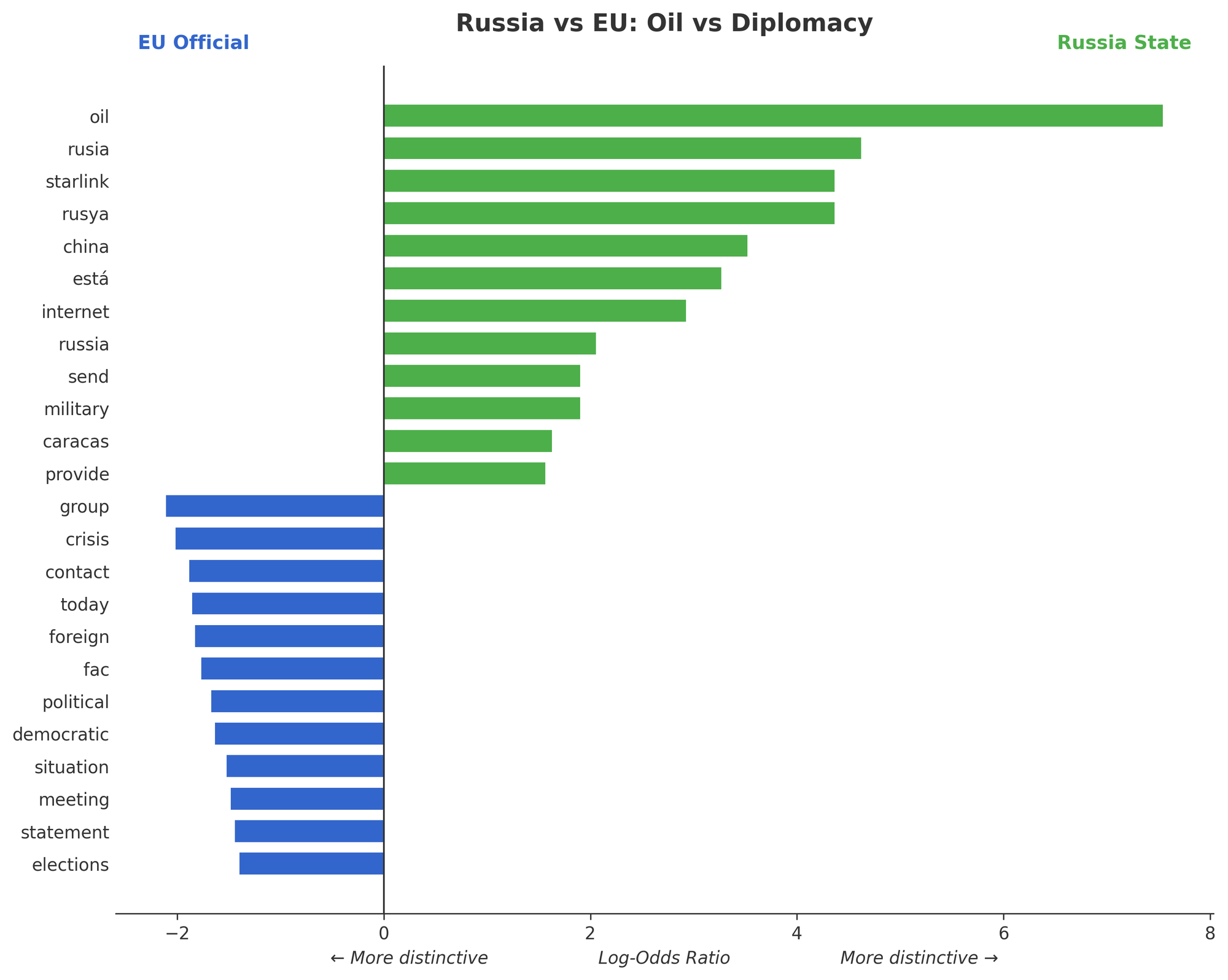
The dominant Russian frame is defined by a single, massive linguistic outlier: "oil." By reducing a liberation campaign to a resource raid, Moscow attempts to create a moral equivalence between Operation Absolute Resolve and their own predatory foreign policy. Interestingly, the Russian dataset also reveals a paranoia regarding information control, with high-frequency distinctiveness for "Starlink" and "internet," suggesting a fear that US technological superiority will bypass their propaganda firewalls.
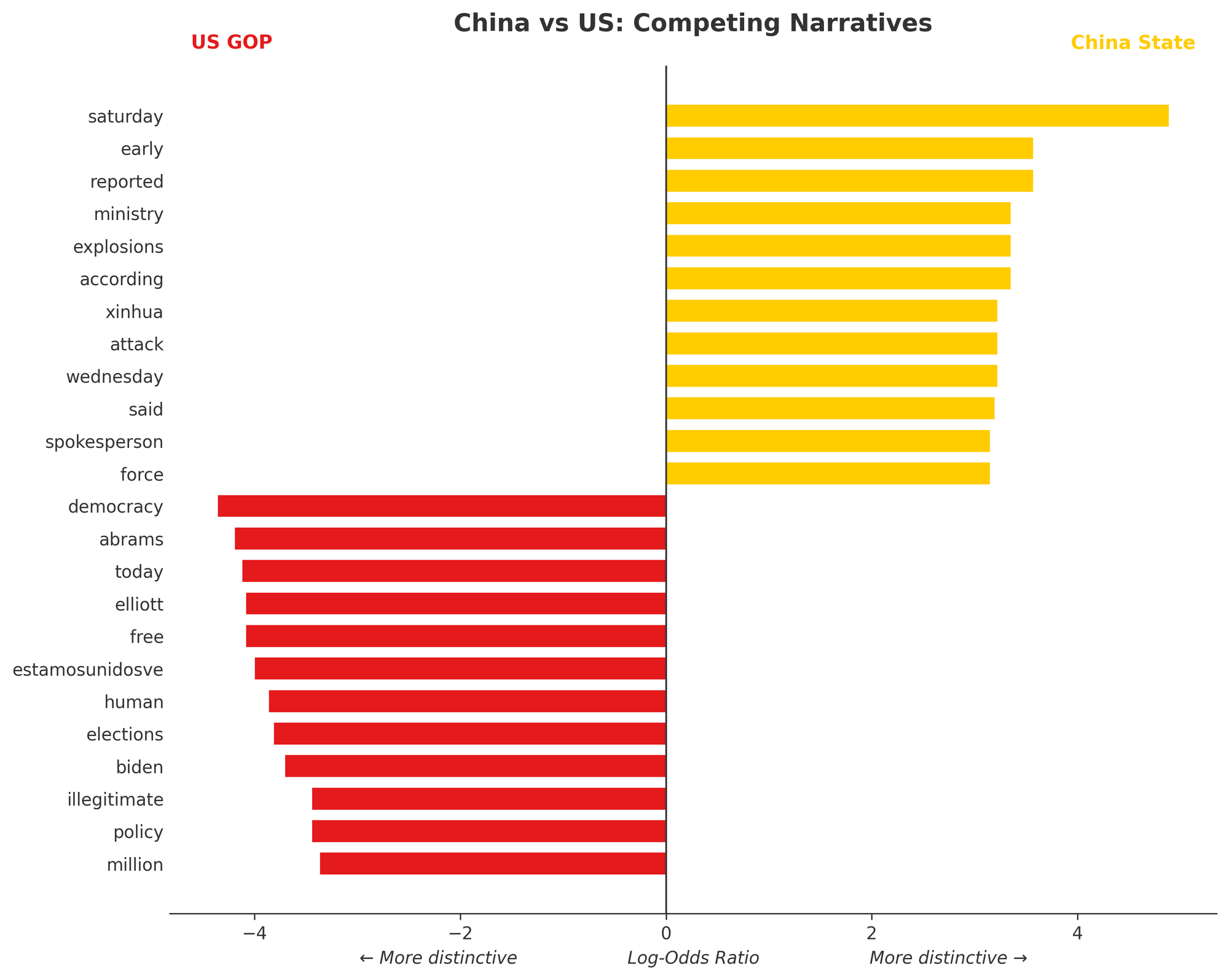
China, conversely, occupies the "Factual / Neutral" quadrant, deploying a strategy we might call "weaponized boredom." The data highlights a vocabulary stripped of all moral weight: "ministry," "reported," "Saturday," "explosions," and "according." This sterile, wire-service style is a deliberate tactic. By treating the dismantling of a dictatorship as a series of dry, administrative updates, Beijing attempts to normalize the Maduro regime and portray the US intervention not as a crusade for democracy, but as a rude disruption of the "proper" international order. They deny the event its glory by drowning it in timestamps.
The European Abstraction
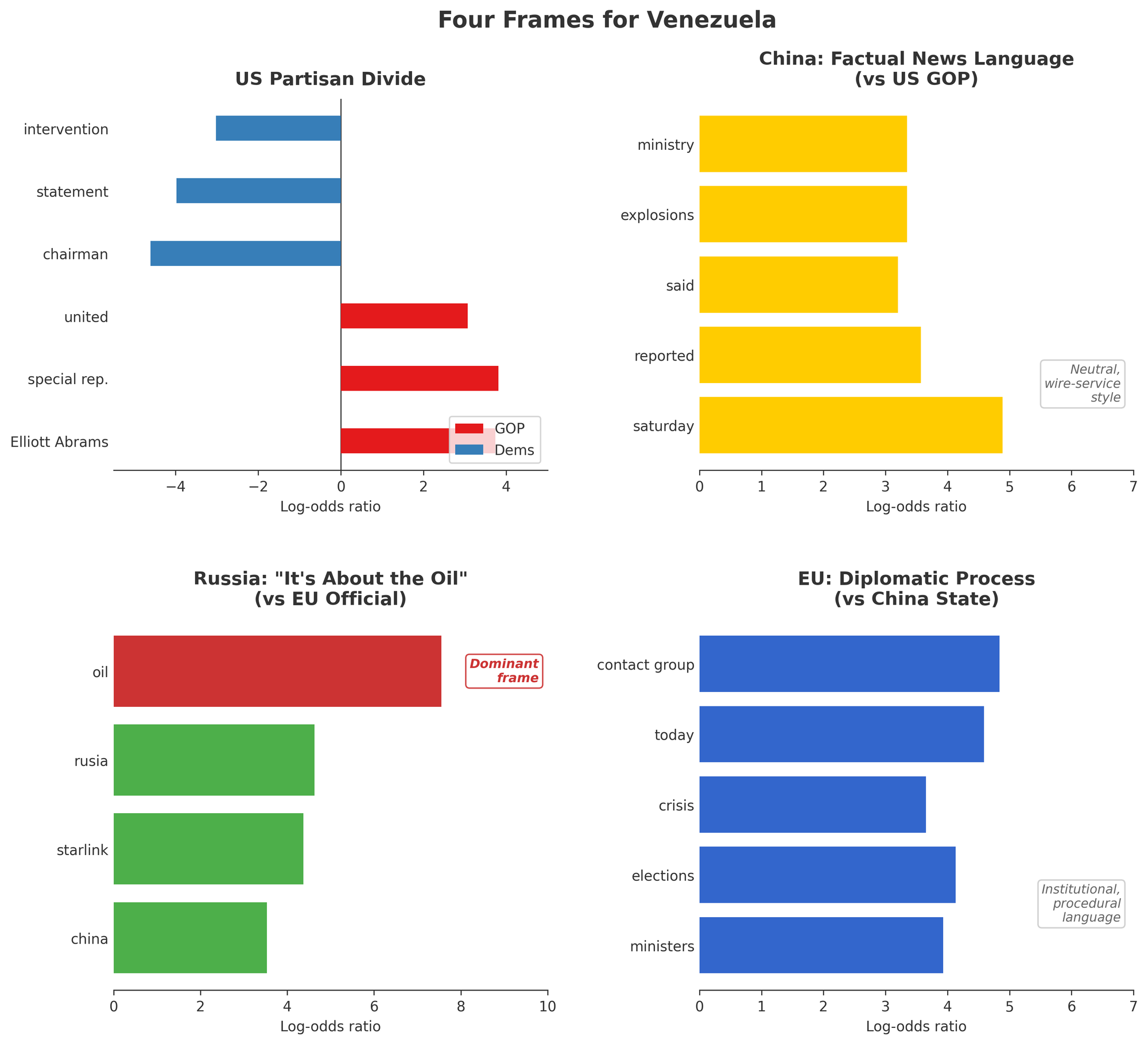
Finally, the data paints a portrait of a Europe that is supportive in spirit but paralyzed in practice. While the quadrant analysis places EU officials in the "Pro-intervention" hemisphere, their distinct vocabulary betrays a deep addiction to diplomatic process over kinetic results. Their discourse is saturated with terms like "contact group," "crisis," "meeting," and "political solution." Unlike the GOP, which speaks of outcomes ("free," "democracy"), the EU speaks of mechanisms. They are fixated on the "diplomatic process" framing, seemingly hoping that if they convene enough "groups" and issue enough "statements," the reality on the ground will polite itself into submission. It is the language of an ally that wants the stability the US provides without having to dirty its hands with the resolve required to secure it.
[1] Monroe, B. L., Colaresi, M. P., & Quinn, K. M. (2008). Fightin’ Words: Lexical Feature Selection and Evaluation for Identifying the Content of Political Conflict. Political Analysis, 16(4), 372–403.https://doi.org/10.1093/pan/mpn018